
Newsletters
May 2026
Share this article
BIF NZ Newsletter
May 2026


Chief Executive’s Report: Julien Leys
Welcome to our May newsletter. It’s hard to believe we are already nearly halfway through the year. As the weather cools down, it’s a good time to take a moment to double check the basics, especially across the health & safety front. A quick check-in with your team and yourself can make all the difference. I’m excited to be attending the BuildLink Tradeshow in Auckland this week on behalf of BIF NZ. I went last year and had a lot of really interesting conversations with people from all across the supply chain, so I’m looking forward to another great couple of days. Come say hi if you’re attending too - the BIF NZ stand will be sitting between our friends at Gunn Talent and Qontro. Last month marked the new financial year, and this month we can expect the New Zealand Government’s 2026 Budget to be delivered on Thursday 28 May. The Minister of Finance has indicated that Budget 2026 will focus on core public services and fiscal discipline while maintaining tight control of discretionary spending to help get the Government’s books back in order. We will be sending out a special update after the 2026 Budget is released to summarise the key areas and what it means for our industry so keep an eye on your inbox on the 28th. I, on behalf of BIF NZ, sit on a government-led building supply chain stakeholder engagement group. Our discussions recently have centred around the current fuel crisis. The consistent message at the moment is that the issue is not about the supply or scarcity of fuel, but simply the price of getting it, given the state of the Strait of Hormuz. We’ve seen a definitive increase is the cost of the likes of PVC, piping, and of course, gas, as well as other critical building products, and delays to overall supply. If you are comfortable sharing what you have seen in terms of costs and delays since this conflict began, please get in touch with me via email (julien@bifnz.co.nz) so this can be relayed back to MBIE. I can anonymise the feedback before I pass it on if you would rather not have your company or product/s named. Even if you have not experienced any changes to supply, demand, cost, etc., this will still be valuable information for the group to know. The situation in the Middle East is fluid and seems to be constantly changing. Our industry is lucky to have this kind of engagement group as a conduit to MBIE. Please take advantage of this opportunity if you have feedback to share.
Ngā mihi nui, Julien Leys Chief Executive, Building Industry Federation of New Zealand
In this newsletter:
- Industry news
- Stats NZ: New home consents up 11% in year ended March 2026
- Forsyth Barr’s Building Sector Insights
- News for GS1 NZ members
Industry news
- 10 April, BusinessDesk: Overseas building products not making an impact thus far
- 12 April, The Post: Building to meet Māori and Pacific needs
- 16 April, RNZ: Fletcher Building says third quarter sales improving but outlook uncertain
- 20 April, The Post: Fletcher Construction sale given the green light by watchdogs
- 23 April, 1News: Plumbers, drainlayers to be able to sign off on more of their own work
- 23 April, RNZ: The $49 billion cost of fixing water infrastructure woes laid bare
- 28 April, 1News: Consent-free granny flat rules to be expanded
- 30 April, BusinessDesk: The gas trap: why NZ companies are running out of time
- 1 May, RNZ: Build-to-rent apartments on the rise

Source: Getty, via BusinessDesk
Stats NZ: New home consents up 11% in year ended March 2026
There were 37,813 new homes consented in Aotearoa New Zealand in the year ended March 2026, according to figures recently released by Stats NZ. In the year ended March 2026, the number of stand-alone house consents was 17,444, up 9.2 percent compared with the year ended March 2025.
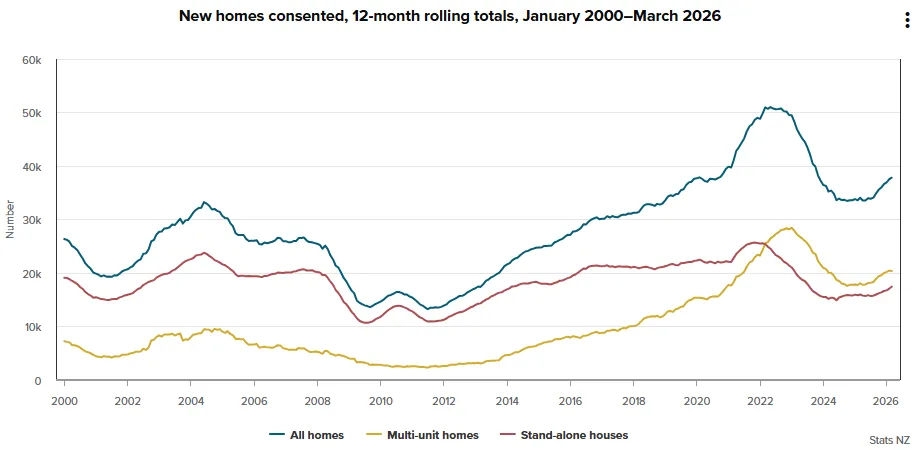
Source: Stats NZ
Forsyth Barr’s Building Sector Insights Forsyth Barr generously shares their insights on the building sector with BIF NZ. You can view their May publication here.
News for GS1 NZ members GS1, one of BIF NZ’s sponsors, has today announced that 2D barcodes will be available at point-of-sale by the end of 2027 for their New Zealand members. Globally, there is a transition underway to having 2D barcodes, such as QR Codes powered by GS1, scannable at retail point-of-sale by the end of 2027. GS1 is the global standards organisation behind the barcode. You may recall that earlier this year, we held an event with GS1 and David Seymour on digital labelling, so it’s great to see such swift progression from GS1 on something so important. Read more about the announcement in GS1’s latest edition of SCAN 2.0.

Pictured, left to right: Sean Goodwin, Julien Leys, and Hon. David Seymour at our digital labelling event earlier this year. Source: GS1